
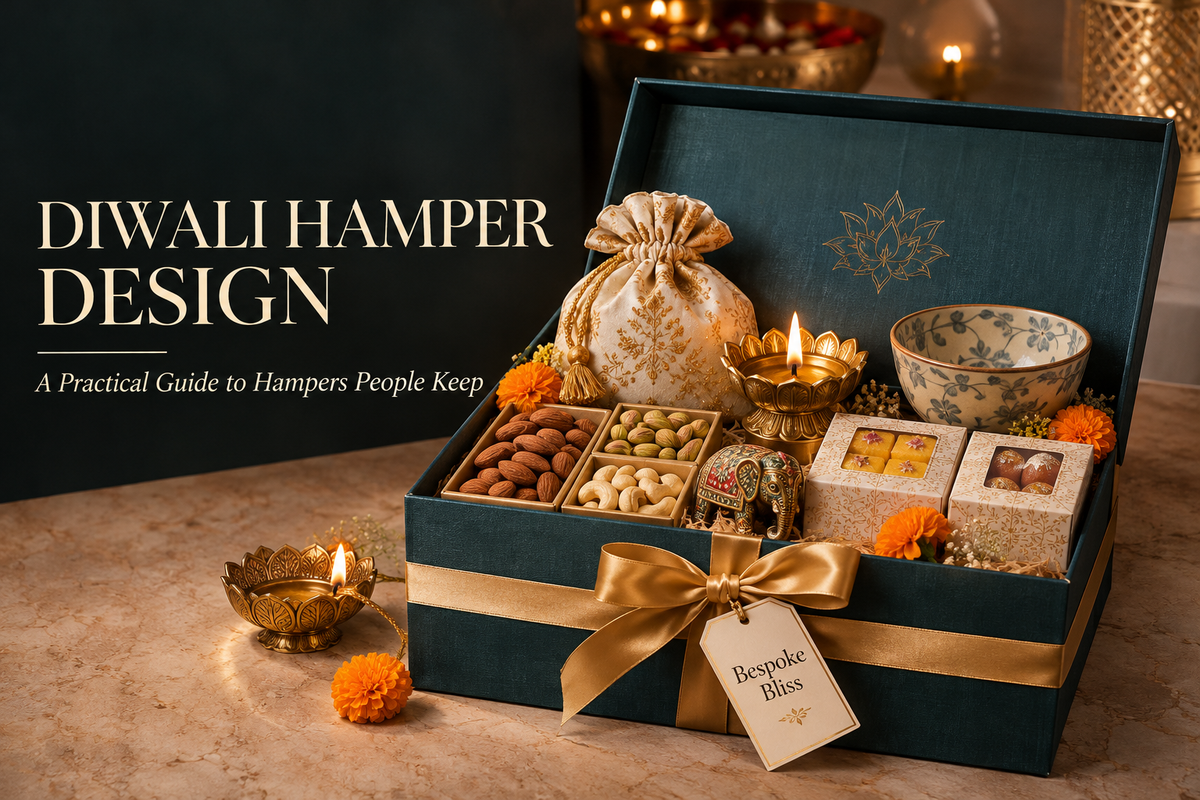
Picture what often happens to a Diwali hamper. The mithai goes to the kitchen, the dry fruits go into the dabba, and the box goes out with the newspapers. Good Diwali hamper design changes that sequence. It decides what the recipient sees first, what they keep, and what the box becomes once the sweets are finished.
This guide covers the design decisions in the order a hamper is actually built, from the brief to the outer sleeve. It also covers two rules most hamper buyers miss: India’s single-use plastic ban and the FSSAI labelling rule for sweets. It works whether you are sending 10 hampers to family or 500 to clients.
What Is Good Diwali Hamper Design?
Good hamper design is the plan behind a hamper, not just its look. It covers who receives it, what goes inside, how the items are arranged, what the packaging is made of and how long each item stays fresh. A well-designed hamper reads as one gift, not a box of unrelated products.
Here is a simple test. Remove the logo and the card. Could the recipient still tell the hamper was chosen for them? If the answer is no, the design work has not been done yet.
Start With the Recipient, Then Pick One Idea
Every strong hamper starts with a single idea. “A quiet Diwali evening at home” leads to diyas, incense and a good tea. “Diwali morning” leads to breakfast items and a serving bowl. “Hosting the family” leads to serveware and dry fruit for guests.
The weakest hampers try to cover everything. A box with chocolates, a candle, a planner, almonds and a bottle of juice has no centre, so nothing in it stands out. Our view is simple: four items that belong together beat nine that do not.
For corporate gifting, the idea should come from the relationship, not the budget. A long-standing client might get a hosting hamper they will use with their family. A new team member might get something lighter and personal, with their name on the card.
Choose a Colour Palette That Stands Out
Red, gold and maroon are the default Diwali colours, so a hamper in those colours looks like most others that arrive the same week. A different palette helps yours stand out without losing the festive feel.
| Palette | How it reads | Pairs well with |
| Deep teal and brass | Rich, calm, modern | Brass diyas, dark chocolate, roasted nuts |
| Ivory and marigold | Fresh, traditional, light | Marigold torans, kaju katli, white ceramic |
| Indigo and copper | Premium, unusual | Copper serveware, spiced nuts, incense |
| Blush and gold | Soft, celebratory | Rose-flavoured mithai, scented candles |
Pick one palette and apply it to everything: the box, the ribbon, the tissue, the card and the filler. Mixed colours make even expensive hampers look improvised.
Lay Out the Hamper in the Order It Will Be Opened
Layout is the part of design most hampers skip. The recipient opens a hamper from the top down, so plan it in layers.
- Top layer: the card and one hero item. This is what gets photographed and shared. Make it the most beautiful object in the box.
- Middle layer: items with the shortest shelf life. Mithai and fresh snacks sit here, where they are found early, eaten first and not crushed.
- Base layer: keepsakes. A brass diya, a serving bowl or a printed tray goes at the bottom. It carries the weight, and it is the last thing found, so it is the thing remembered.
This order also protects the contents in transit. Heavy items at the base lower the centre of gravity, and fragile sweets stay away from metal edges.
Pick Packaging Materials That Follow the Rules
Since 1 July 2022, India has banned a list of single-use plastic items. The list includes thermocol used for decoration and wrapping or packing films around sweet boxes (PIB, 2022). Plastic carry bags thinner than 120 microns have been banned since 31 December 2022, according to the same explainer.
Both rules affect hamper design directly. Swap the usual materials for these:
- Filler: shredded kraft paper, crinkle paper or dried flowers instead of thermocol beads
- Sweet boxes: paperboard boxes with a printed seal instead of cling film
- Pouches: cotton or jute potlis instead of plastic bags
- Outer carry bag: paper or fabric with a reinforced handle
Reusable materials also extend the hamper’s life. A cane basket or a printed tin box stays in a home for years. If you want the gift to be seen after Diwali, design the box as something worth keeping. Our 5 ways to personalise your gift box packaging covers finishing touches that make a box worth reusing.
Label the Sweets Properly
If the hamper includes loose mithai, ask your supplier for its best-before date and put it on the box. Since 1 October 2020, the FSSAI has required sellers to display a best-before date for loose sweets, set according to the product and local conditions (FSSAI order, 2020).
Design the label into the hamper instead of sticking it on at the end. A small printed tag tied to the sweet box, in the same palette as the rest of the hamper, looks intentional. It also tells the recipient which items to open first, which supports the layered layout above.
Personalise the Details That Get Noticed
Personalisation works best on things people actually look at. Three places matter most:
- The card. A handwritten line from the sender carries more weight than a printed paragraph.
- The hero item. A name or initial on the diya, tray or bottle turns a product into a keepsake.
- The box lid. A logo works for corporate hampers, but keep it small. The customised gifting options at Bespoke Bliss include engraving, printed sleeves and branded ribbons.
Customised gift hampers do not need everything personalised. One or two named details are enough. Branding on every item makes the hamper feel like marketing material.
Plan Your Timeline Backwards
Design takes time, especially for custom gift boxes printed in bulk. Work backwards from the delivery date and leave room for sampling. Our Diwali corporate gifting timeline breaks down when to brief, approve samples and dispatch. For budget ranges, see our guide to corporate Diwali gifts under ₹2,500.
[Confirm with client: Bespoke Bliss lead time for custom printed boxes and minimum order quantity.]
Conclusion
Diwali hamper design comes down to four decisions: one idea, one palette, a layered layout and materials that follow the rules. If you are short on time, prioritise the layout and the hero item. Those two choices matter most to how the hamper is received. Brief your supplier on all four at the start, and ask for a physical sample before you approve a bulk order.
Planning hampers for next Diwali? Share your recipient list and budget with Bespoke Bliss, and we will send you a custom hamper design within [X] working days. Request a design consultation
Frequently Asked Questions
1. How far in advance should I order custom Diwali hampers?
For printed or engraved hampers, start early enough to approve a sample, print boxes and fix any errors before dispatch. Off-the-shelf hampers can be ordered closer to the date.
2. What should I put in a Diwali hamper for a client who doesn’t eat sweets?
Build the hamper around a non-food idea instead. A hosting theme with serveware, a home theme with diyas and incense, or a wellness theme with tea and spice blends all work without mithai. Add roasted nuts or savoury snacks if you still want something edible.
3. Can I mix food and non-food items in one hamper?
Yes, and most good hampers do. Keep food items sealed and separated from candles, incense or fragrances so the smells do not transfer. A partitioned box or individual pouches solve this.
4. How do I keep sweets fresh in a Diwali hamper?
Pack mithai in sealed paperboard boxes and place them in the middle layer, away from candles and fragrances. Ask the sweet supplier which of their sweets keep longest, and choose those if the hamper will travel or wait before opening. Check the best-before date on every box.
5. What size should a Diwali hamper be?
Size the box to the contents, not the other way round. A half-empty box looks padded even with filler, and an overfilled one crushes the sweets. For office delivery, choose a box that fits on a desk and can be carried with one hand.